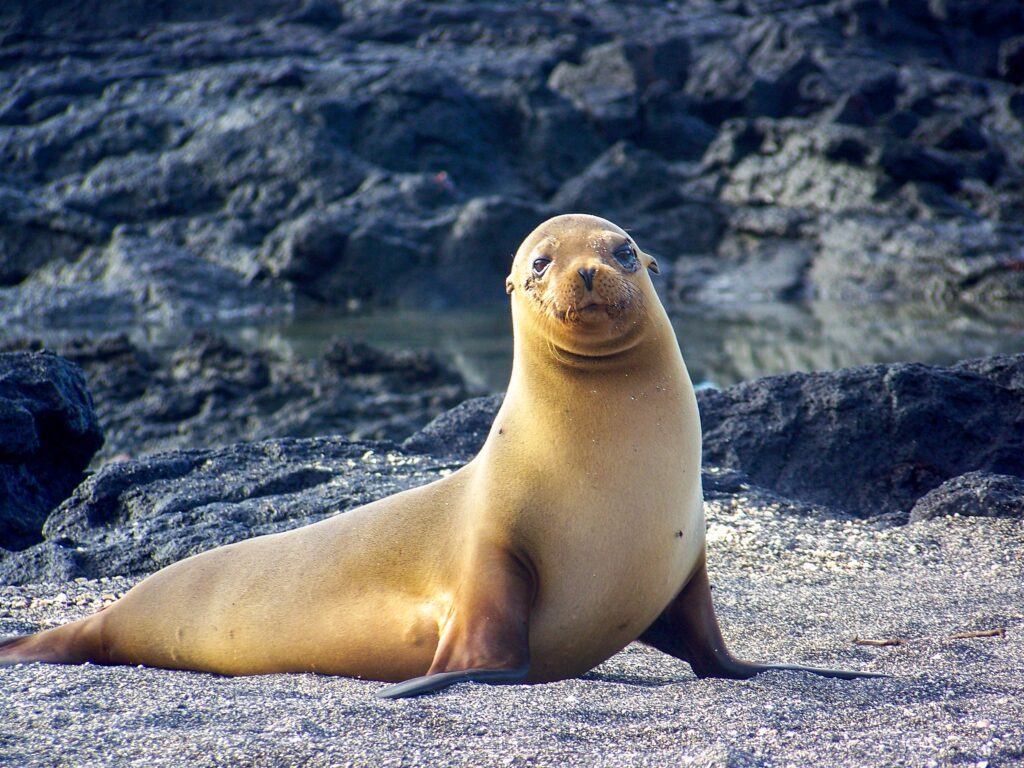
The blue-footed booby does not care about you. This is the first thing you learn in the Galapagos and the thing that changes everything.
It does not fly away when you approach. It does not perform. It stands there, three feet from your shoes, looking at you with the same mild curiosity it shows a rock or a piece of driftwood. You are not special here. You are not a threat. You are simply another animal standing on a volcanic island in the middle of the Pacific, and that rearrangement of your place in the natural order is worth more than any photograph you will take.
The archipelago everyone thinks they know
The Galapagos has an image problem. It is so photographed, so documented, so narrated by television crews that most visitors arrive feeling they have already been there. They have seen the marine iguanas. They have watched the footage of hammerheads at Gordon Rocks. They know about Darwin and finches and evolution.
What they do not know — what the cameras never capture — is the silence.
Not metaphorical silence. Actual silence. The kind you hear at six in the morning on a beach on Isabela before the day boats arrive from Santa Cruz. The kind that sits inside a lava tunnel on Santiago where the only sound is your own breathing and the faint drip of moisture that has been dripping for eight hundred thousand years. The kind that makes you understand, in a physical way, that this place was not made for human consumption. It was made before humans existed. It will be here long after we are gone.
The difference a guide makes
There are roughly two hundred licensed naturalist guides in the Galapagos. We work with eleven of them. Not because the others are bad — most are competent, well-trained professionals. But competent is a low bar when you are standing in front of a phenomenon that reshaped our understanding of life on Earth.
The guides we choose are people who have spent decades in these islands. Who can tell you not just that this finch is a large ground finch but why its beak is three millimeters wider this year than it was ten years ago. Who notice the shift in current temperature that means the whale sharks will arrive two weeks early. Who know that the best place to see the waved albatross courtship dance is not the platform where everyone stands but a rocky ledge forty meters to the left, where a pair has been returning every April since 2014.
The difference between a good guide and a great one is the difference between visiting the Galapagos and understanding it. We are not interested in the first option.
What a slow Galapagos looks like
Cruises dominate the islands. They are efficient, comfortable, and they allow you to cover enormous distances in a short time. They are also floating hotels that carry you from site to site on a fixed rotation, shared with forty or sixty or a hundred other passengers who are all looking at the same booby at the same time.
We do something different. We build land-based programs that move between islands at a human pace. You stay in small lodges. You eat where the locals eat. You spend mornings in the water and afternoons on trails that the cruise passengers never reach because their schedule does not allow it.
One afternoon last November, a client of ours — a teacher from Vancouver — sat on a black lava rock on the western coast of Isabela and watched a flightless cormorant dry its wings. She sat there for forty minutes. No one told her to move. No one honked a horn or rang a bell. Her guide sat nearby, quiet, available if she had questions, content to let the moment be what it was.
She wrote to us a month later and said that was the moment she understood why Darwin stayed.
The islands are not a checklist
The temptation in the Galapagos is to see everything. Every island, every species, every geological formation. Tick the boxes. Fill the camera roll. Go home satisfied that nothing was missed.
But the Galapagos rewards the opposite impulse. It rewards the traveler who decides that today, this beach is enough. That watching a single sea turtle navigate a reef for an hour teaches you more about the ocean than snorkeling five different sites in five different days.
We design journeys for that kind of traveler. The one who came to see the Galapagos not as a bucket-list destination but as a place that still has something to teach us. About nature. About time. About what it means to stand somewhere truly wild and feel, for once, that you are the guest.